I was 24 when I saw my first Mara crossing. Since then I have witnessed more than I can count — but I will never forget the first one. Jonas explains what the migration really is, which season suits you and what the biggest misconception is that disappoints travellers.
I was 24 years old when I saw my first Mara crossing. About a thousand wildebeest stood at the river's edge — nervous, hesitating. Then, without any obvious reason, the first one jumped. Then the rest. All at once. Crocodiles cut through the water. Chaos, noise, adrenaline. The most spectacular and simultaneously most raw thing I have ever seen.
I have witnessed more crossings since then than I can count. But that first one I will never forget.
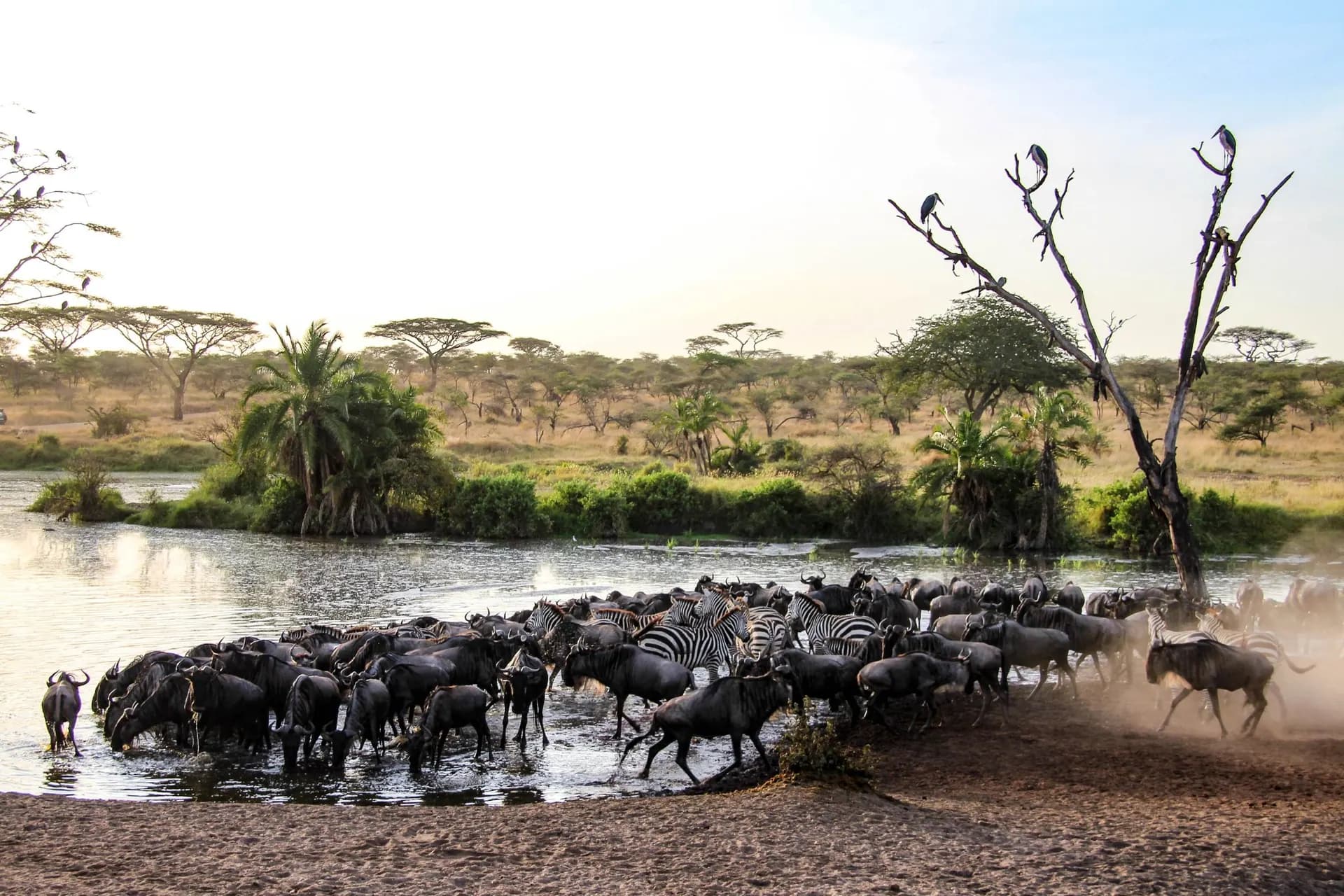
The Great Migration is the greatest wildlife spectacle on Earth: 1.5 million wildebeest, 200,000 zebras and hundreds of thousands of gazelles trek in an endless circle through the Serengeti. But it is not a single event on one day in one place. It is a year-long story — and those who understand that story plan their trip so much better.
What the migration actually is
The term "Great Migration" sounds like one spectacular moment. In reality it is an endless, cyclical movement pattern, driven by rain and grass. The herds follow the grass. When the grass is exhausted, they move on. Always circling, never stopping.
Tanzania holds the overwhelming majority of this story. The Masai Mara in Kenya is only a small part of the cycle — and ironically the part most tourists head to, while the best of the show is in Tanzania. The calving season, the trek through the heart of the Serengeti, the Grumeti crossing — all of that takes place in Tanzania.
January–February: calving season — my personal favourite
In the southern Serengeti, around Lake Ndutu, the most intense drama of the entire migration takes place: the birth.
Each day up to 8,000 calves are born. Wildebeest calves are on their feet within five minutes of birth — they have to be, because the predators are waiting. Lions, cheetahs, wild dogs and hyenas know the calving season as well as the wildebeest do. This is predator heaven at its most raw.
- ◆Calves learning to walk while lions watch on. This is the most dramatic thing you can witness in Africa.
- ◆Cheetah sightings are more reliable in Ndutu than anywhere else in Tanzania.
- ◆Almost no tourists — most people assume January is "not migration season." That is a misconception.
- ◆Prices are 20–30% lower than in the dry peak season.
If you are going to Tanzania only once and have flexibility with timing: consider January–February in Ndutu. The calving season is emotionally overwhelming in a way I find difficult to put into words. This is the Tanzania I would recommend to my own family.
March–April: the trek begins
The long rains announce themselves in March. The herds move slowly northward through the central Serengeti. The least spectacular part of the migration — but also the most raw. You are almost alone in the park. The plains are green and covered in flowers.
Practical reality: in April some roads in the Serengeti can be muddy and less accessible. Consider a fly-in safari in April to avoid time lost to bad roads.
May–June: western corridor and the Grumeti River
In May the leading herds reach the Western Corridor of the Serengeti. The Grumeti River stands in the way.
The Grumeti crossings are talked about less than the Mara. Unfairly so. The Nile crocodiles of the Grumeti are larger than those at the Mara — some reaching 5 metres long. They wait patiently on the banks, motionless as stones. And when the wildebeest jump, everything happens in seconds.
Advantage of the Western Corridor: far fewer jeeps than the north. If you want to experience the migration without ten other vehicles beside you, this period in the Western Corridor is the answer.
July–August: the moment — the Mara River
This is what most people come for. The herds stand before the Mara River and hesitate. For hours sometimes. Sometimes days. Then one jumps. Then all of them. Loud, chaotic and overwhelming.
Honestly, this is also the most crowded moment. In August there can be twenty or thirty jeeps lining the Mara during a crossing. The spectacle far outweighs the crowds — but those who want solitude should choose September.
I never follow the crowd. After 20 years I know which crossing points see fewer visitors — and when the wildebeest are likely to cross there. Book a private safari and don't get swept along in the jeep convoy.
September–October: the golden season
October is my second favourite after the calving season. The herds are moving south. The park is quieter than August. Wildlife density remains exceptional. And the light — October light is gold. Dry. Clear. This is the Tanzania of photographic superlatives.
November–December: back south
The short rains fall — mild and brief. The herds move back to Ndutu for the new calving season that begins in January. The "forgotten" season: prices drop, crowds disappear, the landscape turns green again.
The biggest misconception about the migration
People plan their entire Tanzania trip around one single event: the Mara river crossing. And if that crossing doesn't happen on the day they are there, they are disappointed.
The reality: a crossing is unpredictable. The wildebeest decide when to jump — sometimes they wait three days on the bank. Waiting two hours at the river and seeing nothing: that is Tanzania too.
But those two hours — with the tension, the wildebeest approaching the bank one by one, the electric feeling that it could begin at any moment — that is the experience too. Tanzania always rewards patience. Not always in the way you expected.
Never plan only for the migration. Plan for Tanzania. If the crossing doesn't happen on the day you are there: the Serengeti has ten other spectacular things waiting for you that same day. I guarantee it.
Tanzania vs Kenya for the migration
The question I receive at least once a week: "Isn't Kenya better for the migration?"
My honest answer: Tanzania holds the lion's share of the migration. The calving season, the Grumeti crossing, the trek through the heart of the Serengeti — all of that is Tanzania. Kenya has only the Mara crossing in the north, and that covers a relatively short window (August–October).
For the complete migration story, less crowding, and guide quality in my experience: Tanzania. Always.
When to book for which phase
- ◆July–August (Mara crossing): at least 6–9 months in advance. The best lodges along the Mara are fully booked by April.
- ◆January–February (calving season): 3–5 months in advance is sufficient — less competition for places.
- ◆September–October (golden season): 4–6 months. Excellent choice without an overbooked period.
Ask us for advice based on your specific wishes and travel dates. We plan Tanzania safaris daily and know every phase of the migration from the inside.